
Reconciliation and consolidation aren’t product features. They are the interest payments you make on split software architecture.
Every month-end ritual exists because two systems held the same fact and were allowed to drift apart. Adding faster matching algorithms, checklists, or autonomous AI agents to legacy ledgers doesn’t make the underlying problem disappear. It just automates the tax on bad design.
The only true fix is a ledger where the two numbers were never separate to begin with.
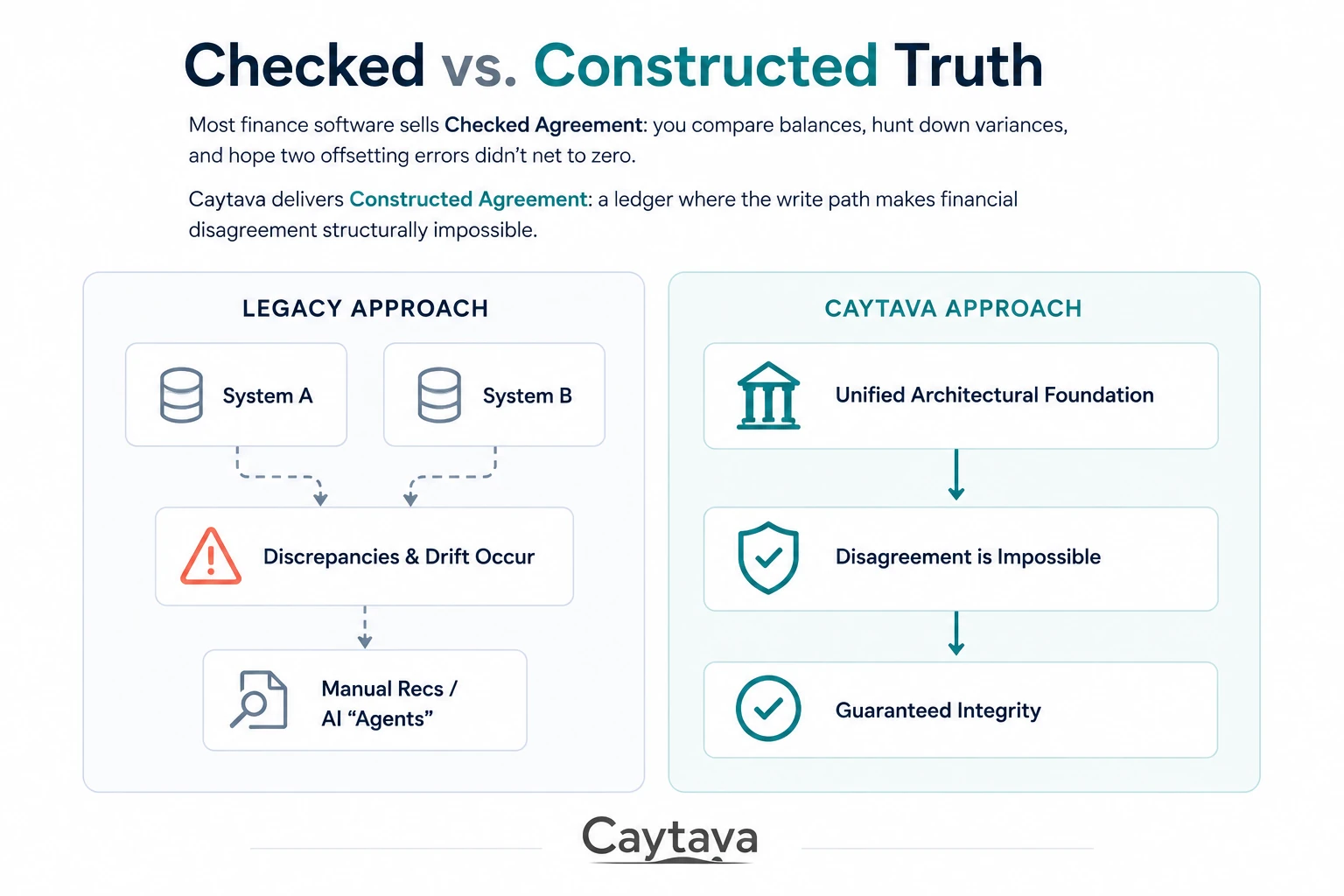
Checked vs. constructed truth
Most finance software sells checked agreement: you compare balances, hunt down variances, and hope two offsetting errors didn’t net to zero.
Caytava delivers constructed agreement: a ledger where the write path makes financial disagreement structurally impossible.
Built-in integrity across your tech stack
1. Bank reconciliation: proven evidence, not balance illusions
- The problem: Balance-level matching hides offsetting errors. Reconciling against pending, unposted feed items creates “ghost” matches that break later.
- The Caytava fix: Every statement line is bound directly to a posted ledger record. A green status doesn’t mean totals happen to match. It means every single item is proven, and unverified items are explicitly assigned to an owner.
2. Hard security: database policies, not UI buttons
- The problem: Approval workflows enforced only in the interface are suggestions. APIs, integrations, and bulk scripts bypass UI controls entirely.
- The Caytava fix: Separation of duties lives in the write path via Postgres row-level security. Data access is enforced at the database layer, where a query for Entity A is physically incapable of returning Entity B’s rows.
3. Native consolidation: zero intercompany drift
- The problem: Assembling group reporting offline via manual eliminations and spreadsheets guarantees permanent ledger divergence.
- The Caytava fix: Entity is a core, balancing dimension. When a transaction spans entities, Caytava automatically generates due-to and due-from legs at write time. Intercompany balance isn’t a month-end reconciliation project. It’s a permanent law of the system.
Responsible AI: Kate as the maker, the system as the checker
Slapping an autonomous AI agent on top of an unreconciled ledger turns AI into a liability with a friendly name. Caytava’s AI assistant, Kate, is designed around strict architectural boundaries.
- No unassisted writes. Kate proposes actions; human oversight approves them; deterministic, validated code executes the entry. Double-entry rules, charts of accounts, and period locks are enforced identically for AI and humans alike.
- Auditable evidence over black-box scores. Kate doesn’t offer meaningless self-reported confidence percentages. She shows you the exact historical transactions used to derive the suggestion.
- Grounded engine queries. Every quantitative answer Kate provides via chat or voice is calculated via live queries against your ledger, never text-based arithmetic guesses.
Why legacy systems can’t catch up
Legacy platforms were built decades ago when ledgers served single legal entities and batch processing ruled. To fix their core seams today would mean breaking thousands of integrations and customer schemas. Their commitment to backward compatibility keeps them locked in the era of checked agreement.
Caytava was built from day one to guarantee financial truth at the database layer.
The takeaway: Stop paying interest on legacy architecture. Move beyond chasing variances after the fact, and run your business on a ledger where numbers cannot disagree.
Common questions
What’s the difference between a reconciliation and a tie-out?
A reconciliation compares your books to an external record, such as a bank statement or a processor report, and explains the difference. A tie-out compares two internal records that should already agree, such as the AR subledger and its control account. Reconciliations will always be necessary because the outside world is genuinely separate; tie-outs are only necessary when your own system keeps the same fact in two places, which is an architectural choice rather than a law of accounting.
Why is intercompany reconciliation so hard?
Because in most systems the intercompany relationship is discovered after the fact rather than enforced at the moment of the entry. Each entity records its side independently, the two sides differ in timing, amount, or coding, and someone reconciles the difference monthly. If the ledger instead requires every entry to balance within each entity and generates the due-to and due-from legs itself, the two sides cannot differ, because they are produced together.
What is maker-checker, and how is it different from an approval workflow?
Maker-checker means the person or system that prepares a transaction is never the one who approves it. It differs from a typical approval workflow in where it is enforced: a workflow usually routes work through screens, while maker-checker has to be a property of the write itself, so an API call, an import, or an integration cannot bypass it. If your controls only exist in the interface, they are conventions rather than controls.
Can AI do bank reconciliation?
AI is genuinely good at proposing matches and codings, and poor at being trusted with the write. The workable division is that the model proposes and a human approves, with deterministic code performing the posting and enforcing double-entry, the chart of accounts, and period locks. Suggestions should also carry auditable evidence in the form of the prior transactions they are based on, rather than a confidence score, because a score tells you how sure the model is, not how right it is.
How do I improve reconciliation without changing systems?
Reconcile more often than monthly. A weekly or daily cadence keeps the unmatched population small enough to investigate while the context is still fresh, and it turns a month-end scramble into a routine. Risk-rank your accounts rather than treating them alike: cash, AR, AP, payroll clearing and intercompany deserve real scrutiny, while low-volume, low-balance accounts can be reviewed on a lighter cycle. Standardise the working paper so every reconciliation shows the same things, namely the source balance, the ledger balance, each reconciling item with its supporting document, and a named preparer and reviewer who are different people.
Then measure the reconciling items themselves, because that is where the real signal is. Track how many are open and how long each has been outstanding. An item that rolls forward two or three periods is rarely a timing difference any more; it is usually an error, a duplicate, or something nobody understands, and ageing the list surfaces those long before the balance does. Automating the data pull with a direct bank or card feed removes a whole class of keying errors on top. None of this requires new software, and it recovers most of the value that better tooling would.
See it on your own books Explore accounting & close
Related reading: The case for the first modular ERP · The close that never sleeps · How Kate answers from real ledger queries